
 NDVI Definition
Rather than simple channel differences, a better
measure of the physiological activity of plants is the Normalized
Difference Vegetation Index (NDVI). It is defined as follows:
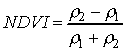
where  l and 2 are the
reflectances derived from the measured radiances of the NOAA-AVHRR
channels 1 and 2. The denominator in the equation is a normalisation
factor, which partially compensates for the difference in surface
reflectance associated with solar elevation or satellite viewing
angles. The reflectance is given by:
l and 2 are the
reflectances derived from the measured radiances of the NOAA-AVHRR
channels 1 and 2. The denominator in the equation is a normalisation
factor, which partially compensates for the difference in surface
reflectance associated with solar elevation or satellite viewing
angles. The reflectance is given by:

where L is the measured radiance and G the global irradiance. At the top of the atmosphere, G is equal to the extraterrestrial intensity Io. The albedo and the reflectance are equivalent if it is assumed that the surface reflects according to the cosine law and when atmospheric influences are disregarded. Since the NOAA-AVHR-Radiometer always covers an area of at least 1 km2, the measured signal will be a mixture of vegetation, bare soil and shadow. Only by assuming that the soil is black in both channels can the NDVI be calculated as defined above. The radiance measured by the satellite sensor is the sum of the atmospheric path radiance and the surface leaving radiance. Thus, the AVHRR-detector receives a signal depending on both the atmospheric constituents and the geometry of the sun/target/sensor. The complexity of the surface, however, does not allow accurate specification of the bi-directional reflectance, Thus, we have to assume a Lambertian surface. In order to reduce errors in the NDVI to less than 10%, it is recommended to use only off-nadir viewing angles of less than ±14°. In order to correct the NDVI for atmospheric influences, sufficient information must be available on atmospheric constituents which have an effect on the extinction, such as aerosols and water vapour. Failure to correct the NDVI for a turbid and moist atmosphere results in a reduced NDVI.
