
 Reflectance of some surfaces
1 denotes paddock, 2 dry soil, 3 wet soil, and 4 coastal waters.
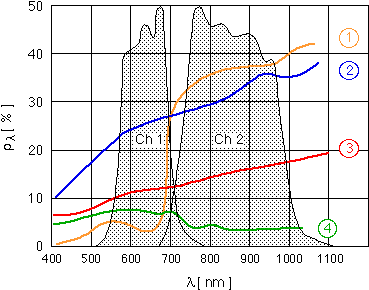 Plants have a low reflectance up to a wavelength
of about 680 nm. This high absorption of short wavelength energy
is used by the plant for photosynthesis. For wavelengths between
680 and 750 nm, the reflectance increases rapidly by a factor
of between three and four, stabilizing again at the longer wavelengths
towards the infrared. In the near infrared, the high reflectance
of plants prevents overheating.
Plants have a low reflectance up to a wavelength
of about 680 nm. This high absorption of short wavelength energy
is used by the plant for photosynthesis. For wavelengths between
680 and 750 nm, the reflectance increases rapidly by a factor
of between three and four, stabilizing again at the longer wavelengths
towards the infrared. In the near infrared, the high reflectance
of plants prevents overheating.
Ground, when not covered by vegetation, shows no large variations in spectral reflectance with wavelength. The reflectance increases with the wavelength in a linear fashion, the slope depending upon the soil type and the surface moisture. Using these spectral characteristics of plants and soil, the state of the vegetation is often classified from data from the first two channels of the Advanced Very High Resolution Radiometer (AVHRR) of the NOAA polar-orbiting satellites series, which have a relatively high spatial resolution and a daily global coverage. These two channels are in the visible and near-infrared. The schematic spectral response of the AVHR-Radiometer, as well as the spectral reflectances for different ground covers, can be seen in the figure.
