
 Simulation of the vegetation index
 In order to investigate atmospheric influences
on the NDVI, model calculations of the vegetation index were performed,
with the assumption that surfaces reflect according to the cosine
law. The two wavebands selected represent the first two NOAA satellite
channels. Molecular and aerosol
extinction, water vapour absorption and ozone absorption provide
the strongest influences on the vegetation index at these wavebands.
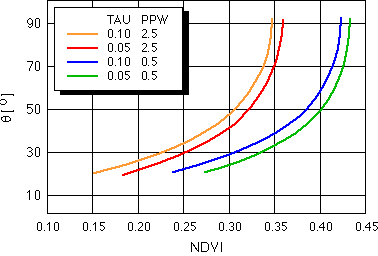
The NDVI was simulated at the top of the atmosphere for eight
sets of atmospheric conditions and eight different sun elevations,
from 20 to 90 degrees, with a constant surface albedo of 0.1 for
channel 1 and 0.37 for channel 2. The resulting NDVI at the surface
is 0.574. The aerosol optical depth is comparatively low and for
the model calculations it is assumed to be independent of the
wavelength. For presentation purposes, the calculations are given
for the mean ozone concentration of 0.30 cm (at standard temperature
and pressure). The aerosol optical depth is denoted by TAU and
the precipitable water by PPW in the figure.
In order to investigate atmospheric influences
on the NDVI, model calculations of the vegetation index were performed,
with the assumption that surfaces reflect according to the cosine
law. The two wavebands selected represent the first two NOAA satellite
channels. Molecular and aerosol
extinction, water vapour absorption and ozone absorption provide
the strongest influences on the vegetation index at these wavebands.
The NDVI was simulated at the top of the atmosphere for eight
sets of atmospheric conditions and eight different sun elevations,
from 20 to 90 degrees, with a constant surface albedo of 0.1 for
channel 1 and 0.37 for channel 2. The resulting NDVI at the surface
is 0.574. The aerosol optical depth is comparatively low and for
the model calculations it is assumed to be independent of the
wavelength. For presentation purposes, the calculations are given
for the mean ozone concentration of 0.30 cm (at standard temperature
and pressure). The aerosol optical depth is denoted by TAU and
the precipitable water by PPW in the figure.
The results are summarised on the following page.
