Noise (1 of 2)
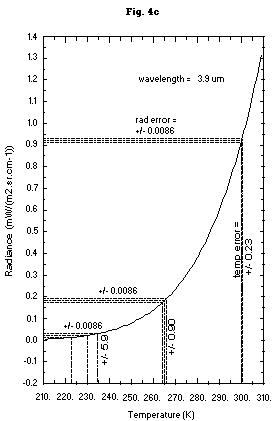
Figs. 4c & 4d are plots of radiance versus temperature for the GOES channels
at 3.9 um and 10.7 um respectively. The accuracy of the radiance measurements
at each wavelength is constant and is shown by the horizontal dashed lines in
each figure. However, temperature measurement accuracy, shown by the
corresponding vertical dashed lines in each figure varies with respect to scene
temperature. Notice that the radiance at 10.7 um (Fig. 4d) is fairly linear with
temperature compared with radiance versus temperature at 3.9 um (Fig. 4c).
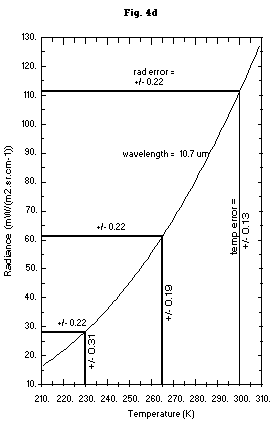 This means that 10.7 um radiance temperatures may be determined very accurately
for both warm and cold scene temperatures. In the 3.9 um figure, notice how
radiance increases rapidly with increasing temperature. Also notice how "flat" that
curve is at cold temperatures. Since the inherent measurement accuracy of the
GOES instrument at 3.9 um is constant, the result is a much less accurate
temperature measurement at cold versus warm scene temperatures. Interpretation of
this figure shows that GOES' 3.9 um imagery is less useful for analyses in cold
temperature regions, such as thunderstorm tops; however, for measurements of warm
surface temperature the 3.9 um channel does a fine job.
This means that 10.7 um radiance temperatures may be determined very accurately
for both warm and cold scene temperatures. In the 3.9 um figure, notice how
radiance increases rapidly with increasing temperature. Also notice how "flat" that
curve is at cold temperatures. Since the inherent measurement accuracy of the
GOES instrument at 3.9 um is constant, the result is a much less accurate
temperature measurement at cold versus warm scene temperatures. Interpretation of
this figure shows that GOES' 3.9 um imagery is less useful for analyses in cold
temperature regions, such as thunderstorm tops; however, for measurements of warm
surface temperature the 3.9 um channel does a fine job.
Continue or go back to the main comparison page.