
 Potential Vorticity and the Tropopause (1)
The Ertel potential vorticity is a conservative quantity during adiabatic evolution.
In the scalar product of the definition, the main component is the vertical one .
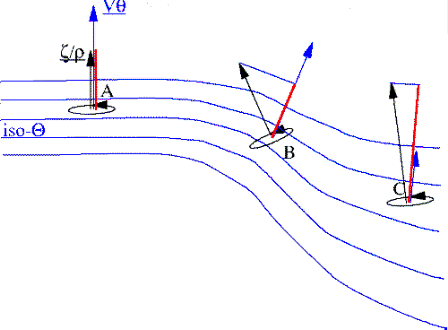
The potential vorticity is therefore mainly the product of the vertical component of the absolute vorticity multiplied by the static stability. Thus, the potential vorticity indicates that an air parcel may see its absolute vorticity increased when the static stability decreases, as is graphically shown the figure.
 |
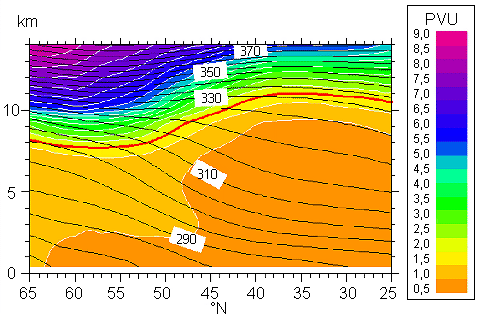
| Winter climatological distribution of atmospheric PV |
|---|
 |
The potential vorticity is usually measured in potential vorticity units or pvu.
A pvu is 10-6m2.K.s-1.kg-1. The PV is relatively low in the troposphere (smaller than 1 pvu) and the PV gradient is flat. There is, however, a tendency to have a slightly higher PV at high latitudes than near the equator because of the planetary component of the absolute vorticity.
At the tropopause, the PV gradient becomes very strong because of the very high values of the static stability in the stratosphere. Above the surface of 1.5 or 2 pvu, the PV increases very quickly in the stratospheric air.
The iso-PV surfaces of 1.5 or 2 pv units define the dynamical tropopause. This separates tropospheric air from stratospheric air in terms of PV (the classical definition of the thermal tropopause is in terms of temperature gradients).

