
 How is Sun-Synchronism Achieved?
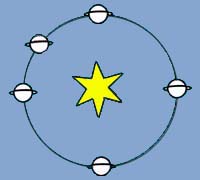
Keplerian orbit |
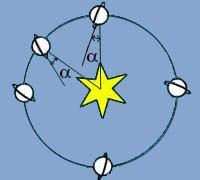
Sunsynchronous satellite orbit |
A strictly spherical Earth would have an orbit as described by Kepler's Law, so the orbital plane would have a fixed orientation in a fixed stars orientated frame of reference. This is not the case for sun-synchronous satellite orbits.
By what means could a satellite be sun-synchronous, and so not strictly follow a Keplerian orbit?
The effect of sun-synchronism is caused by the forces due to the non-spherical shape of the Earth. It is one of the most important causes of orbital perturbations, and is used to advantage here to realise sun-synchronism.
As a first order correction to a spherical shape, the Earth may be treated as an oblate spheroid of revolution. Its cross-section is approximately elliptical, with an average distance of 6378.140 km from the centre of the Earth to the equator and a distance of 6356.755 km from the centre to the poles. So, the Earth is like a sphere with a 21km thick belt running around the equator.

| As a first approximation, the Earth is like an oblate spheroid of revolution. |
The induced gravitational potential U of the Earth is given (approximately) by:
U = -( me/r)[ 1 + (1/2)J2( me/r)[ 1 + (1/2)J2( /r)2(1-3sin2 /r)2(1-3sin2 ) + ... ] ) + ... ]
|
| where | is the Newtonian (or universal) gravitation constant,
me is the mass of the Earth, r is the distance to the Earth center, is the equatorial radius of the Earth,
is the declination,angle,
and J2 is the quadrupole gravitational coefficient of the Earth. |

The gravitational equi-potential surfaces are also oblate spheroids of revolution.
How does this non-spherical gravitational potential affect a satellite orbit?
Imagine a quasi-circular, near polar, low-altitude orbit, with an inclination greater than 90°.

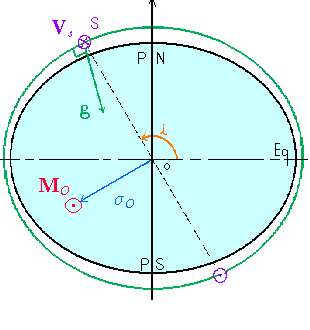 Click on the figure to see it in close-up.
This is a consequence of the kinetic momentum theorem. The moment of the gravity force with respect to O is not null when the inclination is not either 0° or 90°. In the case illustrated, it is pointing out from the plane of the figure. The mean effect is to slowly precess the satellite kinetic momentum about the polar axis; in the sense of the apparent movement of the sun for i > 90° and in the opposite sense for i < 90°. This moment is null for i = 90°, hence there is no precession for an exact polar orbit.
It is possible to express the rate of change of the right ascension of the
ascending node  as :
as :
d /dt = -<n>[(3/2)J2(/ )2(1- )2(1- 2)-2cos 2)-2cos  ] ]
|
| where |
<n> is the anomalistic mean motion constant,
J2 is the quadrupole gravitational coefficient of the Earth, is the equatorial radius of the Earth,
is the semimajor axis,
is the eccentricity,
and is the inclination. |
Another effect of the equatorial belt is to cause the argument of perigee to rotate or precess.
