

Motta, Bikos,
Zajac, Weaver, Zehr
Development work and review continued, on a new VISIT session, “Subtropical Cyclones.” It includes satellite intensity analysis, subtropical cyclone climatology, and structure differences from tropical cyclones. R. Zehr and B. Motta developed the training with input from TPC. The session is nearly complete, and has been significantly upgraded from the original version with inclusion of new data sets.
Bikos, Weaver and Motta developed a new teletraining session titled “Mesoscale Analysis of Convective Weather using GOES RSO Imagery.” The first session was given on July 24 and as of September 21 there have been 7 of these sessions delivered. Of the 7 sessions delivered so far, 149 students at 40 NWS offices have participated.
CIRA VISIT staff participated in conference calls regarding the upcoming workshop on winter storms, general project information, and future directions in training development. One of the new requests from the project sponsor is to add recorded audio to developed and future training sessions.
B. Motta and B. Zajac tested the audio capabilities available for recording audio and annotations for VISIT training sessions. Two systems have been identified as possibilities for making recordings.
B. Motta comprehensively reviewed the recorded VISIT training session on Sounder Data and Products by Scott Bachmeier, Gary Wade, and Gail Bayler. This version of the lesson, based on the VISIT teletraining session, allows users to hear the narrated instruction, see the slide annotations/pointings, and start/stop the training as desired. Additional plans for distribution and generating metrics are in development.
B. Motta participated in conference calls directed at defining a Winter Weather Professional Development Series Outline for the NWS. From this outline, key aspects of training will be selected for one Winter Weather training workshop to be held at COMET.
During this quarter 49 VISIT teletraining sessions have been delivered, with 774 students from 228 NWS offices participating.
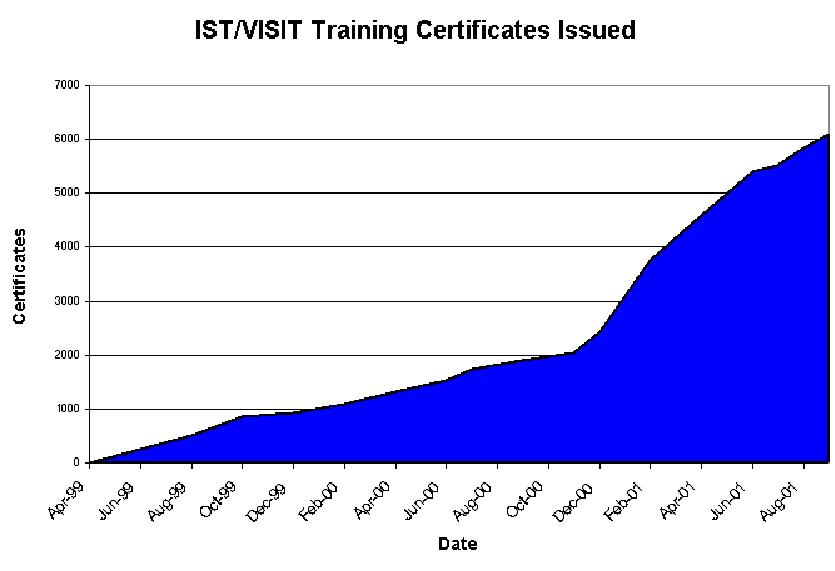
A training certificate of completion is sent out to participants who return student evaluation forms. The following graph shows the total number of certificates issued since we started this in April 1999. The rapid increase in 2001 is the most notable feature.
The below tabulation shows the number of VISIT teletraining sessions by course title, sessions, number of NWS offices and number of individuals that have been awarded certificates since April 1999.
IST
PDS/VISIT Teletraining Sessions Summary
April
1999 through September 25, 2001
Web versions of certain VISIT sessions may be visited at the following addresses:
Boundary Detection: http://www.cira.colostate.edu/ramm/visit/boundaries/title.asp
CONUS Cloud to Ground Lightning Climatology: http://www.cira.colostate.edu/ramm/visit/lightning/title.asp
Convective Initiation by Low-Level Boundaries: http://www.ssec.wisc.edu/visit/lessons/bndry2/viewmaster.html
Detecting Boundaries: http://www.cira.colostate.edu/ramm/visit/boundaries1/title.asp
Elevated Mesoscale Ascent: http://www.cira.colostate.edu/ramm/visit/ascent/title.asp
GOES enhancements/color tables in AWIPS: http://www.cira.colostate.edu/ramm/visit/istpds/awips/awips_1.html
Lake-effect snow (student guide, web based session link temporarily on this page): http://www.cira.colostate.edu/ramm/visit/les/title.asp
Mesoscale Analyses and Techniques: http://www.cira.colostate.edu/ramm/visit/mesoana/title.asp
NDIC: http://www.cira.colostate.edu/ramm/visit/ndic/title.asp
Rapid Scan Operations: http://www.cira.colostate.edu/ramm/visit/rso/title.asp
Tropical Satellite Imagery and Products: http://www.cira.colostate.edu/ramm/visit/tropical/title.asp
QuikSCAT: http://www.cira.colostate.edu/ramm/visit/qscat/title.asp