Campbell
G.G. Campbell visited Eumetsat,
collaborating with K. Holmlund. The standard cloud tracking software
of Eumetsat was adapted to include the geometric calculation of cloud height
with stereo. Using the 5 km resolution IR imagery of Meteosat 7 and
Meteosat 5, we were able to match the temperature to height algorithm in
a majority of cases to plus/minus 100mb. Certain groups of cloud
had inconsistent heights and these could be traced to problems (or areas
of improvement) in the algorithms. The semi-transparency correction
failed to correctly recognize some thin cirrus clouds, assigning middle
cloud levels to these high clouds. For inhomogeneous cloud situations,
the temperature retrievals select the coldest pixels for the cloud height,
where as the stereo scheme estimates the height of the most common cloud.
Comparisons were also made between the visible stereo estimates with 2.5
km resolution data. The height matching with the temperature method
was not as good, because inhomogeneous clouds have a bigger effect on the
visible, than IR radiances. Click
on figures to enlarge
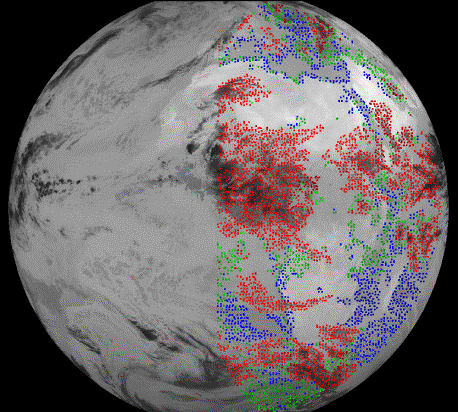
Figure 1 |
IR Stereo Heights from Meteosat-7
plus Meteosat-5:
All possible objects with correlation > .4; Green 4 km < Z < 7 km; Blue < 4 km From G.G. Campbell and K. Holmlund, 1999 |
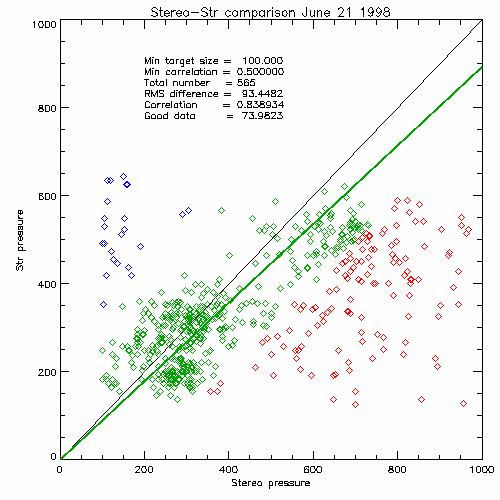 |
Temperature to Pressure vs
Stereo to Pressure algorithm results:
Str = Semi-transparent Temperature Corrected Cloud Tops Stereo = Geometric Pressures Failures of the Temperature Method (BLUE) show area where the temperature algorithm needs tuning. The temperature algorithm is designed to select the coldest cloud pixel so the clouds shown in RED are mismatching because the stereo method uses all pixels of the cloud edge. This indicates that the stereo analysis should select only uniform cloud types for tracking. |
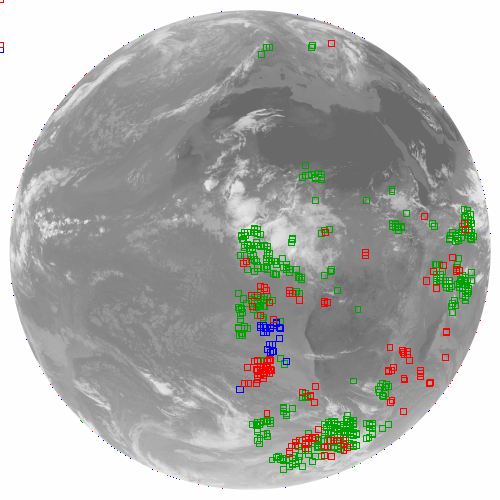
Figure 3 |
Semi-transparent clouds with matching
stereo heights
The colors match the previous figure. The organization of the matches lends credence to the conclusions. |