Dostalek, Motta, Molenar, Weaver, Bikos, Connell, DeMaria, Zajac
J. Dostalek and J. Weaver began a study of a multiple splitting thunderstorm events that occurred in the Texas panhandle on 25 May 1999. Loren Phillips (SOO, LBB, NWS) is a partner in the study, which includes satellite radar and gridded surface and upper air data.
D. Bikos has brought in some AWIPS cases for the HP machines at CIRA. He has also provided satellite data to FSL for the May 3, 1999 case, so they can make it available to NWS offices as AWIPS cases.
D. Bikos, B. Motta, B. Zajac attended the High Plains Severe Weather Conference in Goodland, KS
B. Motta made a presentation at the Southern Region NWS/Global Hydrology and Climate Center regional analysis and prediction workshop.
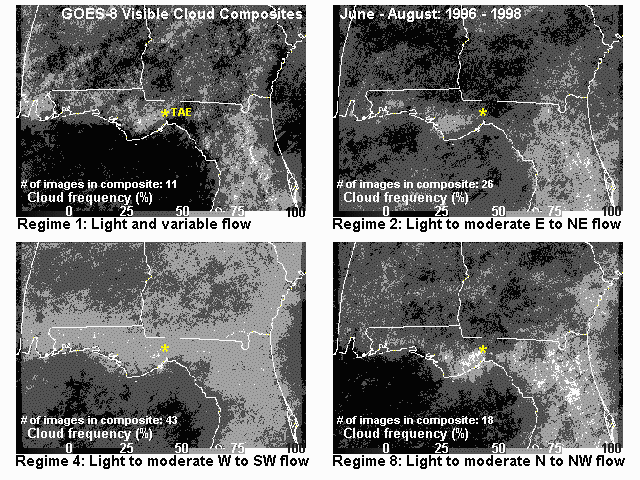
CIRA collected visible, 3.9 um and 10.7 um imagery for June, July, and August 1999 in support of the NWS Tallahassee, Summer Sea-breeze climatology project. This year the analysis of the imagery has shifted from a qualitative averaging approach to a quantitative cloud frequency approach. The following image shows an example of the visible cloud frequency composites for 2115 UTC for 4 different regimes for 1996-1998. The data from 1999 are being processed and quality checked and will be added to the composites in the future. A short paper entitled "GOES-8 visible cloud frequency composites of the convectively active sea breeze under stratified synoptic flow over the Florida Panhandle" was prepared and submitted for the AMS annual meeting in January 2000. Click on image to enlarge
M. DeMaria is collaborating with
the NCEP Environmental Modeling Center (EMC) to assess the impact of AMSU-A
data on their global data assimilation system (GDAS) in the vicinity of
tropical cyclones. The GDAS will be run with and without the AMSU
observations for a few cases from the 1999 hurricane season.